This week, we turn closer to home. All the selections are from The Canadian Journal of Psychiatry. The Canadian connection includes the journal, of course, as well as the data and topics. That said, these topics – suicide, school cellphone restrictions, and irritability – are relevant for those in my home country and elsewhere.
In the first selection, Sara Zulyniak (of the University of Calgary) and her co-authors look at suicide trends in Canada from 2000 to 2024, drawing on Statistics Canada data. “Overall trends and many Canadian age and sex groups have seen declining rates of suicide mortality beginning in 2018, though some young female groups have continued to have increasing rates of suicide from 2000 to 2024.” We consider the paper and its implications.
In the second selection, Kimberley C. Tsujimoto (of the Hospital for Sick Children) and her co-authors analyzed data on the early implementation of school cellphone restrictions in Ontario and the association with screen use and mental health outcomes for children and youth. “We found that greater adherence to school cellphone restrictions was associated with lower social media use, and subsequently fewer depressive and anxiety symptoms.”
In the third selection, Michael Uebel (of The University of Texas at Austin) writes about irritability in depression and anxiety. “Irritability carries information that standard depression scales miss, and that tracking it offers an early, actionable read on whether to continue or modify a treatment.”
ChatGPT is the most downloaded app in history. People turn to AI for travel tips and restaurant advice. But what about its impact on those vulnerable to psychosis? Or those experiencing psychosis?
In a new research letter published in JAMA Psychiatry, Zachary Bergson (of Vanderbilt University) and his co-authors attempt to answer those questions by analyzing more than 200 000 mental health notes at an academic centre. “In this systematic analysis of AI psychosis, documented in the EHR of a large US medical setting, psychosis-worsening interactions with conversational AI were most common among patients experiencing their first episode of psychosis.” We consider the study and its implications.
In the second selection, from The American Journal of Psychiatry, Naomi Cruz (of Rutgers University) and her co-authors look at benzodiazepine dispensing in the United States, using data on 1.1 billion prescriptions. “From 2013 to 2024, the national prevalence of dispensed benzodiazepine prescriptions declined by more than one-quarter, with reductions across all patient age groups and most prescriber types as well as in the mean dose dispensed per benzodiazepine prescription.”
And in the third selection, from The Washington Post, Dr. Nebyou Belay, a psychiatrist, writes about the influence of the Internet on psychiatric diagnoses. He argues that social media can encourage people – particularly young people – to adopt psychiatric diagnoses before their symptoms have been properly assessed, blurring the line between normal distress and mental illness. “Psychiatry should help people understand what they are experiencing. Increasingly, however, the Internet gets there first.”
Cannabis was the only thing that helped him sleep, my patient explained. He also described positive information he had found online. He then asked: Will it affect my psychosis?
In a new review published in The Lancet Psychiatry, Wayne Hall (of The University of Queensland) and his co-authors look at cannabis use and major mental disorders. The topic isn’t new, of course, but their approach is impressive: they draw on many types of studies (epidemiological, genetic, experimental, and preclinical) to try to establish the connection – or the lack of connection – between daily cannabis use and psychosis, bipolar disorder, anxiety, and depression. “There is credible evidence that regular cannabis use plays a contributory causal role in psychosis.” We discuss the paper and its implications.
How have cannabis and alcohol misuse changed over time? In the second selection, from JAMA Psychiatry, Beth Han (of National Institutes of Health) and her co-authors use a US dataset with almost 190 000 participants, and show a sharp rise in cannabis use disorder. “More effective cannabis use disorder treatments are needed.”
Finally, in the third selection, Dr. Sivabalaji Kaliamurthy (of Howard University) writes about cannabis in an essay for The New York Times. He notes a big increase in the potency of cannabis and describes his worries as a physician, particularly about adolescent users. “The question now is whether we are willing to regulate and enforce product safety, especially to protect the most vulnerable among us.”
The voices became quieter, and the paranoia lessened. But my patient continued to complain about his lack of motivation. He left the hospital, but he never rejoined the workforce. Negative symptoms are difficult to treat.
Could an app help? In a new JAMA Network Open paper, Abhishek Pratap (of Boehringer Ingelheim Pharmaceuticals) and his co-authors attempt to answer that question. They describe a randomized clinical trial of 457 individuals with negative symptoms of schizophrenia, comparing those receiving an app (CT-155) intervention featuring evidence-based psychosocial treatments against an active control. “These findings support CT-155 as a potential adjunctive therapy for patients for an indication of negative symptoms of schizophrenia with a high unmet need for FDA-approved pharmacologic treatments specifically targeting negative symptoms.” We discuss the paper and its implications.
As more and more people turn to chatbots for mental health advice, we should ask: how can we make them safer? In a new Comment from npj Digital Medicine, Joanna M. Streck (of Harvard University) and her co-authors describe experimentation with an AI chatbot and the lessons learned. “We describe suicide safety monitoring features for a chatbot implemented in a high-risk clinical setting and make recommendations for chatbot design alongside human-monitoring and triage.”
Finally, in the third selection, Dr. Danilo Rojas-Velasquez (of Harvard University) writes about clinical notes and language in a paper for Academic Psychiatry. He offers suggestions for learners, noting how language affects care – a topic now even more relevant with the growing use of AI scribes. “We watch language do its quiet work, and we write notes that will, in turn, shape how the next team thinks.”
This month, Reading of the Week celebrates its 12th anniversary. Over these past years, the program has grown, establishing partnerships in seven countries and promotional arrangements in three more.
A quick word of thanks for your ongoing interest.
In March 2020, mental health services were transformed by the reality of the pandemic and the webcam became indispensable. Today, many clinical programs offer a mix of video, in-person, and phone visits. But what are the outcomes?
In a new JAMA Network Open paper, Samantha L. Connolly (of Harvard University) and her co-authors attempt to answer that question. Using Veterans Affairs’ data involving 813 699 participants, they compared different modalities of care and looked at outcomes over a year, including inpatient admissions. “In this comparative effectiveness study, receiving mental healthcare via video was associated with improved clinical outcomes compared with receiving care via phone or in-person.” We consider the paper and its implications.
In the second selection, Rakhi Dandona (of the Public Health Foundation of India) and Dr. Rajesh Sagar (of the All India Institute of Medical Sciences) write about suicide prevention in JAMA Psychiatry. They offer lessons from India, where one in five suicides occur. “If most suicides occur in LMICs, then the future of suicide prevention should increasingly be shaped by evidence generated within them.”
And in the third selection from The Globe and Mail, Pat Barford writes about being a “fake patient,” to use her term. She describes her work as a standardized patient for medical students. “I get to watch the highest level of learning happen in real-time.”
This month, Reading of the Week celebrates its 12th anniversary. Over these past years, the program has grown, with partnerships in seven countries and promotion in three more.
A quick word of thanks for your ongoing interest.
We usually think about depression on the individual level – our patients tell stories of lost jobs, broken relationships, and personal tragedies. But what are the societal costs? In a new Nature Medicine paper, Zhong Cao (of Heidelberg University) and his co-authors attempt to answer that question. They analyzed World Bank data; using labour force participation, education, and work experience, they projected the global economic burden of depression to 2050. “Overall, depression places a heavy strain on the global economy, accounting for about 0.460% of the world’s annual GDP. This burden, however, is uneven across regions.” We consider the paper and its implications.
In the second selection, from JAMA Psychiatry, Philip R. Corlett (of Yale University) weighs in on AI and psychosis in a new commentary. Does AI cause psychosis? Does it exacerbate problems for those who are vulnerable? Corlett reviews this young literature and offers his thoughts. “I suspect that they are not merely old wine in new bottles, but rather new wine in new bottles.”
Finally, in the third selection, Dr. Suzanne Garfinkle-Crowell (of the Icahn School of Medicine at Mount Sinai) writes about therapy-speak and young women for The New York Times. She describes the trend and its implications – and warns against dismissing it. “Ideally, we should create an environment in which girls can stop blaming their own brains for every problem and where they don’t feel they have to be sick to be heard.”
He survived the civil war. But nightmares haunted him and he rarely left his apartment. My patient had survived, yes, but his mental health problems, untreated in his home country, tormented him. In a world of war and violence, my patient’s experiences – the mental illness and the lack of care – are all too common.
With few psychiatrists and psychologists, could non-specialist providers help fill the treatment gap? Anushka R. Patel (of Harvard University) and her co-authors attempt to answer that question in an impressive new systematic review and meta-analysis published in Lancet Psychiatry. Drawing on a quarter century of studies and involving more than 10 000 survivors, they compared non-specialist care with a relatively inactive control. “Our findings support the overall effectiveness of non-specialist provider-delivered psychosocial interventions for violence survivors…” We consider the paper and its implications.
In the second selection, from JAMA, Dr. Ezekiel J. Emanuel and his co-authors write thoughtfully if controversially about artificial intelligence. While many assume that medicine will be reshaped by the collaboration of physicians and computers, they suggest otherwise, focusing on five cognitive medical tasks. “That in the near future AI alone may provide better patient care than physicians or physician-controlled hybrids at 5 fundamental cognitive medical tasks is unsettling but seems probable.”
Finally, we review the latest news with articles from The Toronto Star, The Wall Street Journal, and The Globe and Mail. The topics: addiction treatment, the bias of therapists, and the PTSD and research of Margaret McKinnon.
We are going to teach you how to keep your head above water while you manage your complicated life, even when it feels overwhelming. Writing a book that teaches how to cope, however, feels like a monumental act of hubris. Ask our partners, friends, or kids, and they will tell you that our confidence that we can add value to your struggle, whatever it is, is not based on our having any innate coping superpowers. Rather, we know the evidence, and we have learned how to teach it.
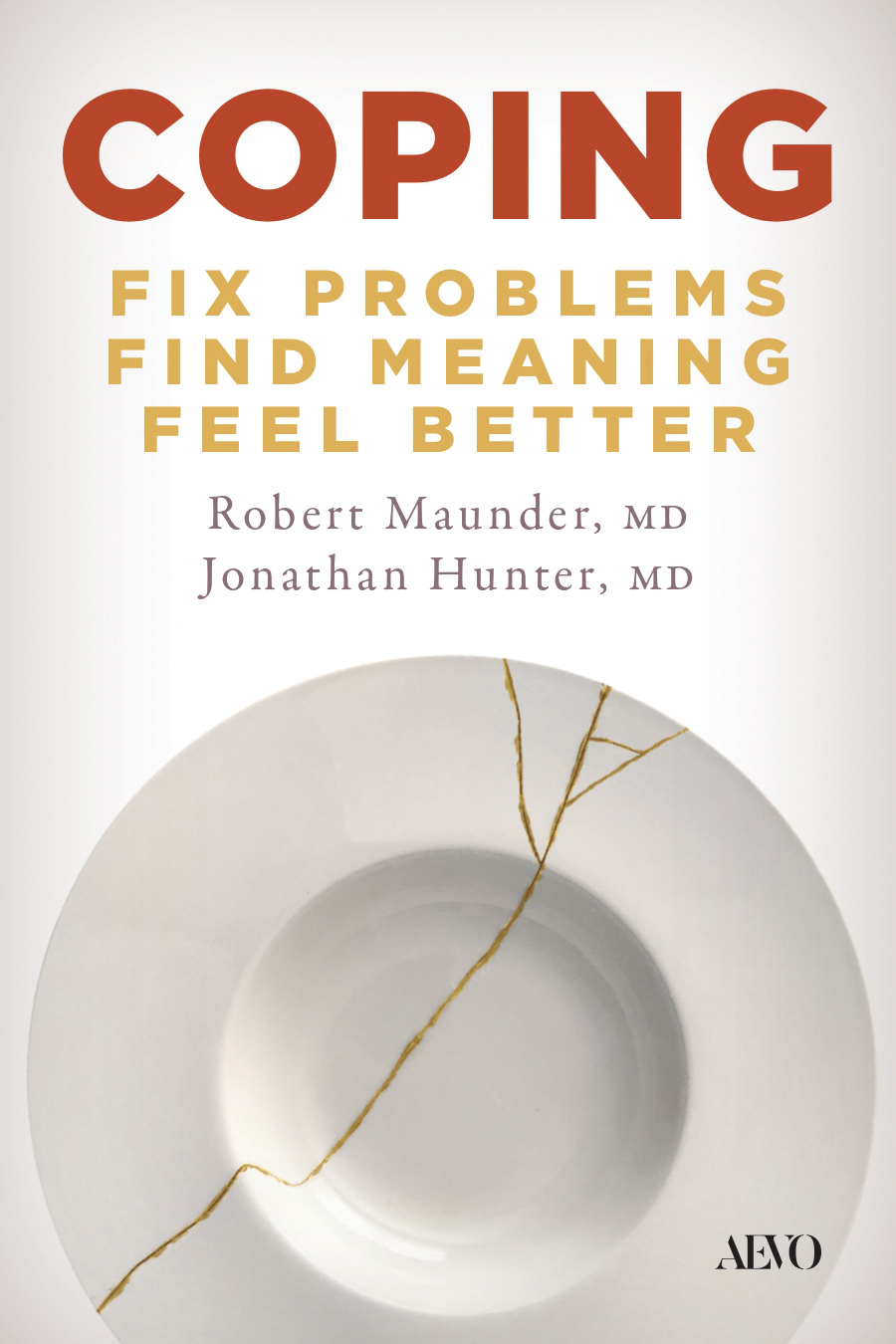
Drs. Robert Maunder and Jonathan Hunter, psychiatrists affiliated with the University of Toronto, open their new book with this comment.
It’s a complicated world, and some people struggle. The authors try to answer a question that is both ordinary and profound: What can we do when life becomes overwhelming? Drs. Maunder and Hunter’s new book, Coping: Fix Problems, Find Meaning, Feel Better, is intended for a general audience and points a way forward, with an optimistic tone, hundreds of citations, and clear advice. The book is about coping. It’s also about trauma, adversity, and finding strength.
This week, there is only one selection: an excerpt from their new book, chosen by the authors.
How should we think about this work? At some level, it’s a really smart self-help book, offering clear suggestions on important topics. How can we sleep better? Page 87 offers tips, drawing on CBT-I. There is also discussion of box breathing (p. 102), cutting back on device time (p. 157), and more.
The book isn’t just about living better – it’s about acknowledging that some are living through extraordinary circumstances. They open by talking about working with patients and providers during the SARS outbreak. The book includes interviews with patients. They also discuss deeper topics like CBT and DBT. At points, the book touches on philosophy; the excerpt that follows includes a discussion of Nietzsche.
The book’s central ideas are simple: fix what you can; feel better about what you can’t fix; and, when suffering persists, live meaningfully.
Thus, the book is really a break from the typical self-help books that populate the shelves of bookstores. They don’t peddle glib recommendations, such as the need to start every day by making your bed. They instead tap the literature and offer good – though not necessarily easy – advice. Coping is ultimately less a promise to make life easier than an invitation to develop a better toolkit to deal with adversity. “Coping as fully and as effectively as you can with all the adversity that is inevitable in your life will reveal who you are.”
During the pandemic, patients would often ask about maintaining mental health during social isolation – as did friends and family. Rowan Diamond and Dr. John Willan (both of Oxford University) wrote a short paper for The British Journal of Psychiatry that I often mentioned, outlining several strategies that could help. Reading Coping, I thought about those conversations – and I thought about incorporating the Maunder-Hunter suggestions into my discussions with patients now; I also thought about the patients to whom I could recommend the book. Frankly, many would benefit.
Of course, this raises a larger question: At a time when we speak more about mental health, why are we collectively doing so badly? Studies suggest that people are more anxious and depressed, feel more isolated, and rate their mental health as poorer. National data finds more homelessness, drug misuse, and workplace absenteeism. In terms of coping, then, we seem to be getting a failing grade. Drs. Maunder and Hunter touch on this topic – we live in “impossible times,” they write in the last chapter. Perhaps we will need to wait for their next book to have a better understanding of how we got here.
In the meantime, Coping is an excellent book on an important topic.
A special word of thanks to the University of Toronto Press for making this Reading possible.
Note: there will be no Readings for the next two weeks.
Studies show that measurement-based care improves patient outcomes, from better functioning to fewer readmissions. Not surprisingly, expert practice guidelines, including the CANMAT clinical guidelines for depression, recommend their use. Yet – despite years of enthusiasm – most of us don’t use scales or questionnaires to monitor symptoms and outcomes.
In a new systematic literature review, Christian Burr (of the Bern University of Applied Sciences) and his co-authors try to identify effective strategies by analyzing recent studies. In their Psychiatric Services paper, they focused on 16 studies in a systematic literature review. “Effective measurement-based care implementation requires context-sensitive strategies, interprofessional collaboration, and active involvement of patients, service users, and caregivers.” We consider the paper and its implications.
In the second selection from The British Journal of Psychiatry, Dr. Scott Monteith (of Michigan State University) and his co-authors write about the evolution of artificial intelligence. They focus on agentic AI (arguably the next big thing), seeing a clear role in education, yes, and in patient care – but they also note problems. “Agentic artificial intelligence systems offer a unique approach to supporting physicians in dealing with the challenges of clinical medicine but also pose validity, privacy, malpractice and security risks.”
And in this week’s final selection, Dr. Paniz Johari, a psychiatrist who works at Northwell Health, writes personally and thoughtfully about the loss of her patient to suicide. In JAMA, she discusses her grief and rumination. “The absence of anything remarkable made it harder to understand and harder to set aside.”
Only three modestly effective medications have been approved by the U.S. Food and Drug Administration (FDA) for the treatment [of alcohol use disorder]. Novel pharmacological targets are desperately needed.
A new paper begins with an old truth: for some, alcohol misuse is devastating, yet effective medications remain few. What then should we make of oral semaglutide?
In a new study published in The American Journal of Psychiatry – quoted above – Joseph P. Schacht (of the University of Colorado) and his co-authors attempt to answer that question. They report on a phase 2, double-blind, randomized, parallel-arm trial involving 50 participants with alcohol use disorder (AUD) who received oral semaglutide or placebo. “Oral semaglutide significantly reduced alcohol consumption, naturalistic alcohol craving, alcohol-related problems, and cannabis use.” We consider the paper and its implications.
In the second selection, Dr. Jeffrey S. Woods (of the University of Texas at Houston) and his co-authors describe the history of coffee. In a clever paper for Biological Psychiatry, they review the literature, ultimately concluding that coffee may be healthful. “Despite millennia of enmeshment in human culture, over the past 50 years the medical community has treated coffee with caution.”
Finally, in the third selection, Clay Routledge (of the Archbridge Institute) writes about the growing awareness of mental health problems and, ironically, our deteriorating collective mental health. In an essay for The New York Times, he sees a connection. “We should try to spend less time stuck in our heads and more time out in the world, pursuing the kinds of activities that support mental health without making us so obsessed with it.”






Recent Comments